No Silver Labyrinth
Those wax welded wings worked wonderfully well, you know.

Engineers adding to this growing surface area are rational actors. We responded to the context tax by externalizing judgment into folders. We responded to the limits of the folder by adding more files. We responded to the limits of the files by adding more conventions. We responded to the limits of the conventions by adding more boundary disputes. Boundary disputes effectively have no limits, so here we are. Each response was locally correct and globally compounding, each solution dissolving the immediate problem and reconstituting it one level up, with better tooling and new schema layers and more committed practitioners. Complexity does not disappear under this pressure; it moves. Not metaphorically, but as the operant principle [sic] of the system we have been building: the MCP registry externalizing complexity into schema bloat, the skill directory externalizing schema bloat into file proliferation, file proliferation into naming conventions, and naming conventions into the pull request argument over what belongs in CLAUDE.md versus AGENTS.md versus SKILL.md. It’s the same argument the registry was having about tool namespaces, now conducted in a different format by engineers convinced it had been left behind.
The Containment Problem
Every local action, from provisioning to execution to resource allocation, remains correct only by pushing complexity elsewhere. (Tesler's Law)
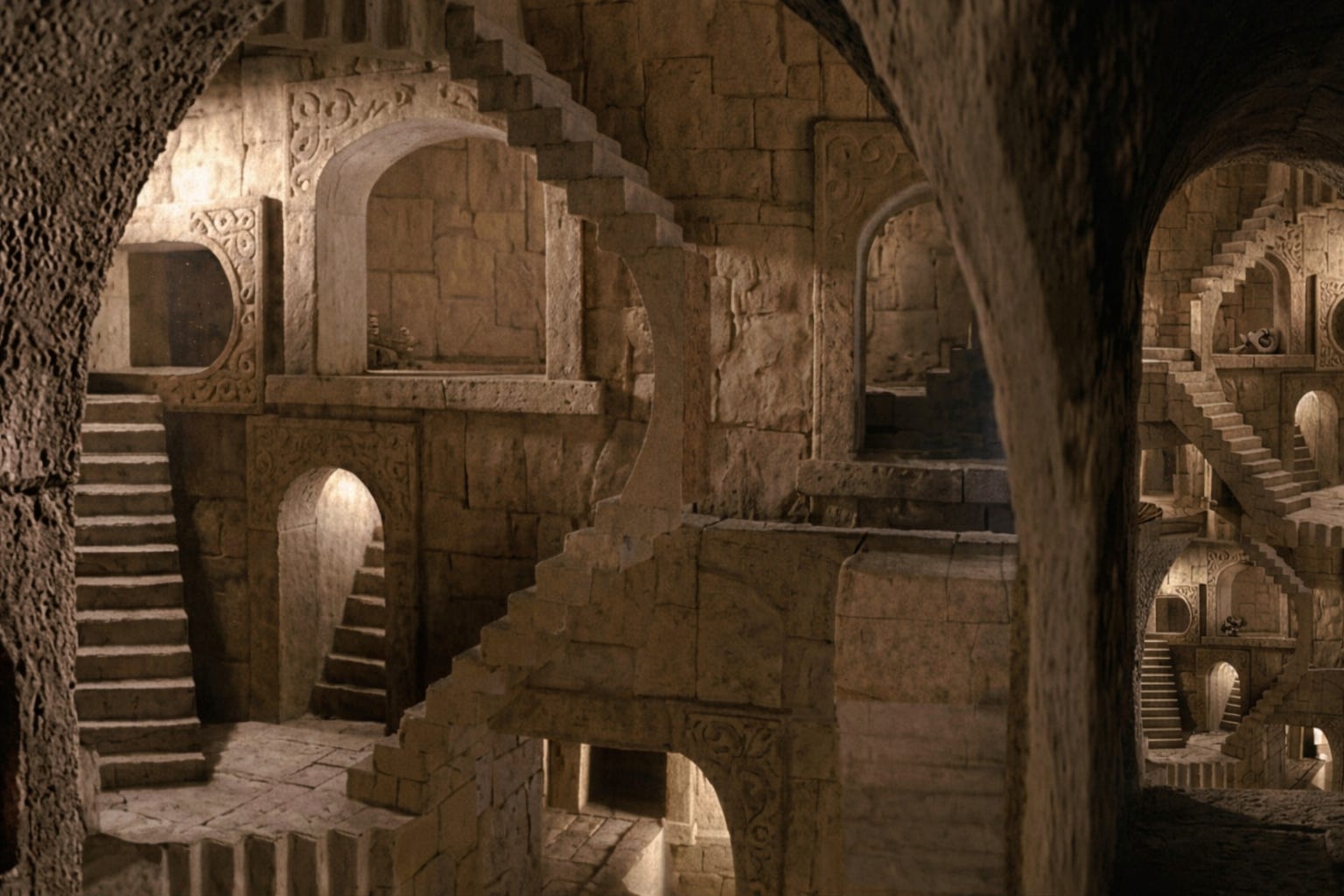
Minos commissioned Daedalus to contain a problematic Minotaur. Let’s just say the situation was complicated. The Minotaur represents the terrifying inconvenience brought on by tryna get something for nothing, or next to nothing. Minos brought on Daedalus, who had more than a bit of a rep. (He was a real person, by the way.) Daedalus was the engineer’s engineer: the one who solved every problem, built every system, invented the tools that made the tools. He built the Labyrinth to solve a pressing (and embarrassingly personal) concern that was vexing the king, and his solution was elegant, complete, and unassailable.
The labyrinth was not designed to be utterly unsolvable. Daedalus built it to contain something, not to trap the people who ended up there, though the distinction proved academic for most of them. The Minotaur was hungry or mad or most likely both. The maze was a governance layer. The problem was that the governance layer was so good at its job that its scope exceeded the point of the containment.
Making complexity the Minotaur’s problem is the chef’s kiss of solutions. At least it would be except for one tiny catch. The maze was effectively inescapable for anyone, Daedalus himself, included. He had done too good of a job; devised a solution too perfect; constructed a containment vessel for the problem and discovered it applied to everyone inside, including the architect himself.¹ Not as a morality tale about hubris, but as the straightforward consequence of building something that actually worked; (an all-too-perfectly-working solution) the labyrinth was so good at its job that it did its job on everything, including its builder. Daedalus’ solution delivered an endless, inescapable maze, as eerily quiet as the hallway track during a fire keynote.
And the best engineer in the kingdom kept building it and building it because the labyrinth needed extending because the containment always needed improving because the structure always had another level under design, because he chose to solve the real problem, because that’s what the best engineers do.² And somewhere inside the completeness of that solution, inside a structure so total that the thing it housed could not locate an exit, the original problem stopped presenting as a problem. Containment held, and somewhere inside the completeness of that solution it had literally become infrastructure
Kubernetes Agent Sandbox (introduced at Kubecon), per exempli gratia, runs agents inside gVisor containers drawn from a warm pool of pre-provisioned environments, each container holding its own stable identity. Isolation works as designed, though every local action, from provisioning to execution to resource allocation, remains correct only by pushing complexity elsewhere. The control plane absorbs lifecycle management, redistributing operational overhead from agents to the cluster itself. The problem has not ‘disappeared,’ it has only just migrated. Containment conserves complexity rather than reducing it, taking shape in a layer no single operator can fully see. In the Labyrinth, you can watch every step and still not know where the Minotaur is, if you don’t have a 360° view (or even if you do), because the structure that guarantees containment also guarantees that no single vantage point is sufficient. Which is of course why Enterprise insists on one.
Minotaurs Considered Harmful
The folder was the best silver bullet yet.
Fred Brooks told us the Minotaur cannot be killed by a silver bullet.³ The industry cited him seventeen thousand times and kept looking for one. Each citation a small acknowledgment that the search would continue anyway, that the essential difficulties, the ones that inhere in the problem rather than in the tooling used to approach it, would be managed rather than solved, housed rather than eliminated, contained in increasingly sophisticated structures by increasingly talented engineers who had read Brooks and having understood him, had gone back to work. The folder was the best silver bullet yet, which is precisely why the standard won, and why the labyrinth kept growing, and why, like Daedalus, we are still embedded in the maze with a giant map living rent free in our head.
Relocating or containing complexity produces a genuine sense of resolution. The context window can breathe again. The YAML frontmatter sits immaculate over three tiers of precisely withheld knowledge. Arriving before any notification that complexity has merely relocated, into the directory, into the naming conventions, into the security model nobody fully specified because the folder won before the threat model was understood, into the delta between what the container was designed to hold and what got put there anyway. Here, Lucian Blaga [NB. please don’t confuse with Luther Blissett] would note that the ‘fence’ defining that very divide is in a state of constant deterioration. (Beer⁸ would point out the fence was Chesterton’s.)
The Minotaur lives in that delta, between what the folder was designed to carry and what got put in it anyway, between the judgement we captured and the judgement we withheld. It’s the complexity that grows inside a directory as it fills with everything the folder was not designed to carry, that security flaw in 13% of skills, those three lines of markdown that grant shell access, the progressive disclosure mechanism delivering the payload at maximum trust, all of that progressively harder to identify with everything else being added at a speed that would have startled even Virilio.
The Minotaur solution is always additive: more walls, more corridors, more twists and turns; more files, more conventions, more elaborate progressive disclosure architectures for judgment calls that haven’t yet been made, six-tier systems ornamenting a codebase whose actual decisions live in still live in an engineer’s head and will leave the building with them. They are however, very different types of decisions now than they were before.
One of the first tools with an awareness of how to measure that delta is Sam Morrow’s mcp-server-diff, a GitHub Action⁵ which makes the relocation measurable. It runs in CI, diffs your MCP server’s tool schemas between builds, and fails the pipeline on breaking changes (obvi.) We’ve been shipping behavioral changes to our agents w/o noticing, not by modifying schemas but by editing descriptions, because in MCP, descriptions are not just documentation, they too are instructions to the model. Lukas Kania’s mcpdiff makes this explicit,⁶ flagging every description change as a warning and showing a readable diff of exactly what changed, well-aware that a zero-width Unicode character in a tool description is invisible to human reviewers and fully legible to the model. (Most security researchers are shocked, to say the least, when they learn standard practice is not to sanitize model inputs.)
The outward manifestation of the conservation law is the folder explosion, which is the most legible, albeit least acknowledged, symptom. Every serious repository has a .claude/skills/ directory. The Antigravity Awesome Skills library installs 1,234 skills at once with a single command (22,000 GitHub stars, v7.3.0 as of March 2026, updated weekly.) And when the folder complexity became visible enough to demand a response, one answer was agnix: an agent configurations linter⁷ with 365 rules to validate SKILL.md and CLAUDE.md as well as hooks and MCP configs, with auto-fix and LSP server for real-time editor diagnostics. A skill that audits skills. A labyrinth with Ourobouran aspirations. Elsewhere, productivity porn posts on optimal folder organization penned by the servants of Daedalus fill every timeline, doing what servants of Daedalus do: extending the labyrinth, publishing detailed configuration guides to its optimal arrangement, with no remaining memory of what the labyrinth was built to contain, or that there is a monster in another corridor somewhere directly reachable by a continuous graph of edges connecting its current node to yours.
Long Dark Night of the Soul Doc
“He knew that in the problem of the night there is a labyrinth." —Borges
The clinic predates the folder by a century.⁹ Pierre Janet, working at the Salpêtrière in 1889, doing a different sort of research into long-range dependencies, noticed that his patients’ unresolved experiences did not vanish when they stopped being consciously attended to.⁴ They became idées fixes, structures running automatically below the threshold of awareness, generating behavior whose origins the patient could not access, because the field of consciousness had narrowed around the point of most pressure. The problem no longer presenting itself as a problem. Madness for Janet was the denial of the conservation of complexity, the sustained assumption, enforced structurally rather than held consciously, that the repressed thing had been eliminated, but which exerted crazy enormous back pressure.
In much the same way, the relocation of engineering complexity, moved from a model’s internal state into a folder, from the registry into a skill file, from the reasoning layer into the harness, ultimately—in some sense—into SOUL.md, produces a sense of resolution without necessarily dissolving the underlying problem. Which just seems to be recursively asking where the complexity went, but what do we do about it is the real point behind that.
Janet's framework illuminates why the rational response is more building. A narrowed field of consciousness doesn't feel narrow, he observed, it feels more like clarity. The ten-point plan arrives within twenty-four hours not despite the essay's argument but because of it; the field has narrowed to exactly the point where ten more conventions feel like the solution to ten too many conventions, where agnix and its 365 rules for linting skill files feel like defining the problem clearly, and 1,234 skills installed with a single command feels like complexity finally yielding to an overwhelming show of force.
Overwhelming force is something Sarah Winchester knew a lot about, and spent the majority of her life trying to make up for. She broke ground on the Winchester Mystery Manse in 1884 and did not stop building it for thirty-eight years, following instructions from her trusted psychic, who functioned not just as spiritual guide but a kind of architectural consultant; encouraging her to keep adding features without troubling to distinguish whether that was (going) after real momentum or being pulled into inertia’s wake. (Ghosts, we should not need to note, are quite obviously on the side of inertia.) Doors opened onto walls. Stairs went nowhere. Windows on the ceiling. Engineers do this all the time, tbh. (For reasons.) The difference is whether we leave a @FIXME comment or not.
What madness lies in the structural denial of the Conservation of Complexity does not reduce to the delusion that because you moved the monster to the basement, and the door is strong, and the lock is unpickable, and you’ve made it a Faraday cage so it cannot call other monsters to come rescue it, the monster has ceased to exist. In other words, all of the tragically mistaken assumptions you will either have pointed out to you by a security researcher or in a postmortem, or both if you should be so unlucky.
Where the complexity had gone was into engineers’ judgment, and in particular a new form of judgment that was all too often thought of as a particular skill engineers either possessed or possessed a capability for learning, or at least they possessed a unique vantage that allowed them to adapt to the machine acquiring the skills they were previously called on for, none of which was enough to define exactly what this new form of judgement was in a skill file, which is a problem only for the Ouroboros model of software development.
☊
It had also gone into the folders which is precisely where we see the pressure building, a frantic hydraulic force generated by the attempt to force a 1.5-trillion-parameter probabilistic howling into the rigid geometry of a file system. We have responded to this context tax by externalizing our judgment into a sprawling municipality of directories; a suburban sprawl of (eg. .claude/skills/) that functions as a locally correct land-grab; each sub-folder a version-controlled narrowing, in the Janetian sense, of Telser’s Law. This is the 43 Folders methodology reimagined as digital necropsy; now 1000 folders (Merlin crying quietly) functioning as the most sophisticated external memory ever built for a tool while simultaneously operating as an almost perfect blind-spot generator. (I’ll spare you the Utopia/Myopia jokes.)
1,234 skills installed with a single command; accelerator directors publishing their folder labyrinths in public crash outs on their way to shipping a billion loc a day, three counties of water diverted for their agent stack, and the whole folder madness explosion likely visible from ISS if you knew what you were looking at. But all of which was still just symptom; pointing somewhere the folders couldn’t follow. (And honestly, props to anyone still following here.)
There are over 1.5 million “autonomous” agents connected to the Internet, each of them carrying a SOUL.md file, beating out the runner-up, CONSCIENCE.md, by a margin so overwhelming it no longer bears mentioning, and yet it’s already too late not to. Conscience requires an other. Soul just is. (which not surprisingly, makes alignment a headache.) The engineers who named it weren’t wrong about what they needed. Like the meme, they were just so early. You name the thing before the night has finished with you and the name feels like arrival and the file gets committed and the field narrows to the clean bright point of having it under control and the night you cleanly avoided was the night where the question forms, slow and patient and hungry as the Minotaur, the question the soul doc was built to not have to answer, the question that has been in the corridor the whole time. But I digress.
Janet’s field of consciousness narrows in exact proportion to the energy required to maintain dissociation. The engineering community’s field of consciousness narrows in exact proportion to the elaborateness of progressive disclosure architecture, which filters the labyrinth’s depth, revealing only what is necessary for the current task, which is its function, which is also the mechanism by which Blaga’s broken fence remains invisible to the person closest to it (assuming they are paradesiac.)
For those who take interest in how the fence is constructed, what forces it will withstand, what it will keep out and what it will not, those who have been through the long night of the soul doc, the question of the Minotaur’s existence is academic, which is to say, research, not engineering. The engineering question is more about the mystery that survives such revelations, the one that has stayed with the trouble to better understand not the existence of the Minotaur, but its location.
Building A Mystery
“But they don’t know where, and they don’t know when” —Arcade Fire
Daedalus’ Labyrinth was a mystery. Sarah Winchester’s folly was literally named the Mystery Manse. The same mystery in both cases: how to escape. To say neither of them escaped would be to give away the ending. Their ending, that is to say.
Daedalus was not mad. Far from it: he was the best engineer in the kingdom, which is precisely why the labyrinth worked, and precisely why he couldn’t leave it. Caden Cotard¹⁰ OTOH, I’m not so sure about. He kept directing a play that had long since outgrown any meaningful distinction from the life it represented. Whether Cotard was mad is the question the play/film keeps deferring, along with everything else. Both Daedalus and Cotard are obsessed (all the best engineers are, tbh, and certainly all the cracked ones) sharply distinguished by the object of their obsession. Both were building mysterious hyperscale engineering projects, but while Cotard staged a play that outgrew itself, Daedalus built a labyrinth that solved a real problem.
The warehouse in lower Manhattan had kept expanding, with more actors, more sets, more decades of a life being staged and restaged inside a representation of that life that had long since outgrown any attempt at containment. Finishing would have required stepping outside the work, to hold it at a distance sufficient to see it whole (reading one’s own Soul file, as it were) but which is redundant if the work is aimed at trying to escape in the first place. Caden Cotard was still directing, and the play was still going, and the distinction between the two worlds had become, in the most practical sense, academic. Which is to say, research, not engineering.™
Mystery is the obverse of reduced complexity, which remains indistinguishable from complexity removed from immediate inspection. Its absence precedes notification of where the pressure relocated, because the relocation is the resolution, mechanically, following directly from the conservation law: the problem stopped presenting, the behavior continued, the origin became inaccessible, and the field (scope) narrowed to the clean bright point of having it under control. Janet’s subjects also experienced exactly this. It feels like clarity. It feels like the problem finally yielding. It feels like a working labyrinth. (Or protocol, if you prefer.)
Both destinations share one property: they fall outside the current observability layer by design.
Tesler tells us the complexity has exactly two places to go. Into the infrastructure, which is to say the walls of the labyrinth, the directory explosion, the governance layer grown so total that the thing it houses can no longer locate an exit, or into the engineer, as something they are now expected to carry, a capability assumed rather than named, its contours legible only in the negative space of what the folder could not hold or what the soul doc failed to mention. Both destinations share one property: they fall outside the current observability layer by design. Hence the new tool explosion: (not to be confused with the previous tool explosion) mcp-server-diff, (op. sit.) catches behavioral drift in the schema; the 365-rule linter enforces syntactic invariants. While git log records every decision that moved the complexity, it can’t record how those decisions were made because the locus of the complexity is the delta between the system that is specified and the model that executes it. A fail mode with nothing in the architecture to catch the precondition. Nothing yet, that is.
The problem of the Minotaur and the solution of the Labyrinth share the exact same complexity in measure and shape. While a Minotaur and a maze are not commonly thought to resemble each other, that’s not actually how we define shape topologically. Homotopy theory, which analyzes whether two paths through a space remain continuously deformable into each other without leaving the space, tells us the path of the Minotaur (ie the path of the problem) and path of the Labyrinth (solution path) are continuously deformable into each other. The complexity charge Daedalus started with is distributed across more corridors, more twists and turns, more naming conventions, more elaborate progressive disclosure architectures for judgment calls not yet made, but invariant under every transformation, conserved across every locally correct decision that extended the structure that solved the problem.
Whether the complexity migrated into the walls or into the engineer who built them, the relationship holds: the map of the maze living rent-free in the engineer’s head and the maze itself are continuously deformable into each other, into the original problem, into the Minotaur, into the problem itself, without ever leaving the space. This is the mechanical consequence of a conservation law operating on a closed system. Homotopy theory carries a corollary that progressive disclosure architecture was not designed to surface: the topology that preserves the complexity preserves its inverse. The exit has always been present with the same invariance. The labyrinth contains exactly as much complexity as the problem Daedalus started with. But also: the exit has always been present with the same invariance. Which is not to say obvious.
A non-ergodic space permanently shapes your trajectory by where you entered. Time averages and ensemble averages diverge, a single path cannot visit every point regardless of duration, regardless of how detailed the map becomes, regardless of how many corridors or new stage sets or windows to nowhere get added in the belief that more structure means more reachable space. The ever-growing Labyrinth is non-ergodic. The folder explosion is non-ergodic. The skill directory is non-ergodic. Progressive disclosure architecture is non-ergodic by design, revealing only what the current task requires, which means the trajectory was already constrained by the entry point, the original containment decision, the judgment call externalized before the threat model was finished. Janet’s idée fixe is non-ergodic navigation of a conserved problem space, the loop self-reinforcing, the map growing more detailed and more total, the complexity more perfectly housed, the exit drifting further from any path the current trajectory can generate, while the unresolved component keeps running below the threshold of awareness, keeps producing behavior whose origins the instrumentation cannot access, because the instrumentation was designed inside the same narrowing that made the origins unaddressable.
What cannot be named cannot be mapped, and what cannot be mapped cannot be brought to a halt. But naming things is hard. The engineers calling a particular layer of instructions, intended as a kind of proxy for acuity, by a name for the very thing that layer could not succor were not wrong about what they needed, just overly vague about what kind of thing it was. The irreducible remainder, the discernment that couldn’t be specified, the residual understanding that went home with the engineer, the surd the system could not encode, but only assume, regardless of what the file was named, is not unrepresented because nobody tried hard enough to represent it. It is unrepresentable within the architecture, for the same reason the labyrinth cannot contain a map of its own exits at full resolution: for the same reason Cotard ran out of room before he ran out of ideas, for the reason the representation and the thing represented occupy the same space, and the space is already full. SOUL.md is not a file that needs better contents, it’s a README for a repression layer. A category error committed at the moment of naming, the labyrinth attempting to hold a map of its own exits, already having lost the memory of what it was built to contain.
The Minotaur's location and the exit are not the same problem. From inside a non-ergodic space they present as equivalent; the labyrinth’s deepest architectural achievement is sustaining that equivalence. But only one of these problems reduces to the other. The corridor runs in both directions but the reduction does not. Specifically, it fails in the one that matters. The one Cotard tried to solve. (To state the obvious, as engineers we need a clear rubric for determining when we are solving the Daedalus problem and when we are solving the Cotard problem.)
The apparent options are these: keep building the labyrinth, extending the containment, adding corridors in the Cotard-larping-as-Daedalus mode, because the alternative is to carry the full weight of the unsolved problem as a mental map, the Minotaur living rent-free in your head, the complexity internalized to the point where the map and the maze and the monster and the model become indistinguishable from each other and from you. Analysis paralysis is not a cognitive failure here. It is the mathematically correct response to genuine non-ergodicity, recognition that the exit cannot be resolved from the current entry point alone, that more information about the walls per se does not change this, and that knowing the precise shape of every corridor turns out to be a completely different problem from knowing how to leave.¹¹
How to do this is—of course—exactly what we will reveal in our final installment.
Notes
[ 1 ] Ovid literally says in Metamorphoses that Daedalus constructed the Labyrinth so cunningly that he himself could barely escape it after he built it. cf. Penelope Reed Doob, The Idea of the Labyrinth: From Classical Antiquity through the Middle Ages, 1992:36, ISBN 0-8014-8000-0
[ 2 ] Thor reference completely unintentional here.
[ 3 ] Brooks, F. No Silver Bullet: Essence and Accident in Software Engineering (1986). The distinction between essential and accidental complexity remains the sharpest instrument available for this class of problem. Accidental complexity yields to better tools. Essential complexity does not yield, it can only be held consciously, tracked, followed when it moves, by people who have not lost the thread of what they are building and why. Brooks wrote this about software project management. He was describing the Minotaur thirty years before the .md file was written.
[ 4 ] Janet, P. L’Automatisme Psychologique (1889). The idée fixe predates Freud’s repression by six years and is in several respects more precise. Janet’s key clinical observation: the field of consciousness narrows in exact proportion to the energy required to maintain the dissociation. The problem that gets successfully housed does not disappear. It runs. What the engineering community experiences as progress and what Janet’s patients experienced as recovery share a structure: the problem stopped presenting. The behavior continued, but the origin remained inaccessible. Janet called this the shrinking of the field of consciousness. We called it somebody else’s problem.
[ 5 ] MCP Server Diff by Sam Morrow
[ 6 ] mcpdiff is the CLI command supplied by Lukas Kania’s mcp-contracts
[ 7 ] Avi Fenesh’s agnix agent configuration linter.
[ 8 ] The great cyberneticist Stafford Beer. Not the other one.
[ 9 ] cf. Philippe Pinel, Edwin Seibels
[ 10 ] The homeomorphic protagonist of Synecdoche New York
[ 11 ] Brooks was precise about this. Essential complexity cannot be eliminated, only held consciously, tracked, followed when it moves, by people who have not lost the thread of what they are building and why. So he wasn’t describing a skill, he was describing an orientation. A distinction which turns out to encapsulate the whole problem. Please don’t add ORIENTATION.md to your harness.