Theseus, Where is Thy STR?
Someone has to hold the other end.

The Labyrinth is escapable. Provably so.
The proof is in the topology. The proof is also in the mythos. And how often does that coincide? (Quite a lot more than you’d think, actually.)
But it also keeps growing, precisely because it is working. This is the thing Janet understood about his patients and Fred Brooks understood about software projects and Karpathy understood about models and Schmidhuber understood about gradients and Cherny understood about code and the thing three engineers who really liked folders understood about delivery but it was Tesler who understood this thing best of all, about complexity itself: that it doesn’t just disappear, it moves, and that moving it is not the same as solving it and all of them gave us some mechanism for keeping track of where it moved to, with some room for argument.
Every new corridor is a locally correct response because the labyrinth is not pathological, despite an apparent tendency for it to be seen that way. In addition to being addition prone, it is—in the strictest engineering sense, and not at all the more recent viral but misused sense of the term—load-bearing. And in its ominous and foreboding history, there were exactly two escapes, and exactly two different methods of escape.

Now You Have Two Problems
Regular expressions, Joel Spolsky famously observed, are a solution that gives you two problems. The joke lands because it’s true and we’ve all been there and not because regular expressions are especially philosophically interesting. It lands because the solution and the problem are, from inside the space where you are trying to use them, indistinguishable until they aren’t, and by then you have committed the regex and the deadline is looming and the second problem is already compounding. It also no longer applies, because nobody has to write a regular expression ever again, and if you are still writing regular expressions you’re prolly¹ NGMI.
The Labyrinth gives you two problems in exactly this sense. From your trapped perspective inside they present as one. Escaping the Minotaur and Escaping the Labyrinth appear, at first to be basically interchangeable outcomes. But this turns out to be a naive assumption. Whereas exiting the maze is the halting solution that subsumes escaping the monster, the problem only reduces in one direction. Because escaping the Minotaur doesn’t answer the Ominous Walker (aka Determinator) problem; all you’ve done is buy yourself more time. It is the Cotardian path: the play keeps going, the stage keeps expanding (bc it’s non-ergodic) and the complexity conveniently relocates into the next corridor.
Once that false equivalence collapses, the next binary trap surfaces: killing the Minotaur versus finding the exit. Eliminating the Relentless Pursuer feels like the critical path, and in a very lethal sense it is. But a dead Minotaur is also a dead end if you’ve no way out of the Labyrinth yourself. Now you’re Cotard sans urgency.
Your periodic reminder that killing the Minotaur is not escaping the Labyrinth
There is a tendency, when extracting engineering lessons from Greek mythology, to focus on the killing. The Minotaur gets dispatched. Procrustes is slain. Apollo killing Python. (Not going there.) The threat is eliminated and hero returns triumphant which is the correct ending for a myth and the wrong mental model for an architecture review. Not because the conservation law does not make exceptions for heroic violence, but whether you took it for tech debt or project risk or any one of a number of proxies for what it actually is, the Minotaur being dead was never the actual condition of your freedom, which is the very thing the Labyrinth is designed to relocate to a place beyond your ability to access. A Minotaur corpse and no way out is not a solution. It’s a warehouse in lower Manhattan with the lights on and the play still going and the distinction between the map and the territory academic in the most practical sense of the word.
Escape was always the ur-problem, because its seeming impossibility is literally the consequence of having perfectly solved the problem to begin with. All tests passing. And yet. There are—quod erat demonstrandum—precisely two ways to exit. As we shall see, while they both remove you from the situation, they differ in critical ways that aren’t merely metaphor or mythic minutia, but have critical implications for how we address the actual complexity of the systems we have built to curtail our more modern monsters of instrumentation, provenance and deployment.
The Great Escape
Having built the labyrinth, Daedalus knew every corridor, every dead end and every locally correct decision that extended the structure over the years of its construction. He had, in this sense, the most complete possible map. Which is not to say that even he could simply walk out. He could not, as Ovid told us, though it’s not clear if the lesson is lost on us or how applicable it is to the problem at hand, which is less about where we hid the complexity and more about how we measure it precisely.
So he did what any overly talented engineer with too much time on his hands and a problem requiring genuine innovation does: he fashioned wings from wax and feathers and went straight up. Not forward. Not through (with apologies to Robert Frost.) Up. The EKG/EEG flatline that suddenly spikes perpendicular, the only geometrically valid exit from a system designed to be inescapable from any one point; straight up to the the omnidirectional vantage from which all points below can be seen simultaneously. Takeoff going vertical asymptote.
The wings of Daedalus gave him the thing you cannot have from inside a non-ergodic space: a 360° view, from high above the maze, a view which progressive disclosure is constitutively unable to provide and precisely what folder architecture optimizes away in the service of keeping the context window clean, and the very thing the labyrinth was specifically designed to prevent any single vantage point from achieving: the whole graph visible at once, every corridor, a dashboard showing every dead end, the mystery of the Minotaur’s location no longer a source of dread and every place the complexity went when it left the field of view, A vantage point, not subject to the containment logic, that could never have been obtained by incrementally improving a map to make it better. Or even continuously, for that matter.
Traces are the Labyrinth photographed from above, after the fact, unrolled into time. LangSmith debugs the pipeline but lives and dies by framework lock-in; Langfuse versions the prompt and owns its stack; Phoenix provides analysis where the others stop at narration, clustering anomalies and scoring what the retrieval actually found. Weave, coming from the training lineage, thinks in runs rather than traces, while AgentOps, which gives you the most agent-native lift of all of these, lets you time-travel the execution, which ultimately is still a corridor view. Every increment of vantage is purchased at the cost of another abstraction layer between you and the whole graph. Each is a partial lift, none outside the containment, all reading a sequential narration of a non-sequential structure. A map that is not the maze. And with mcpdiff flagging every description change as a warning, the deeper problem surfaces: the map is being redrawn while you navigate it.
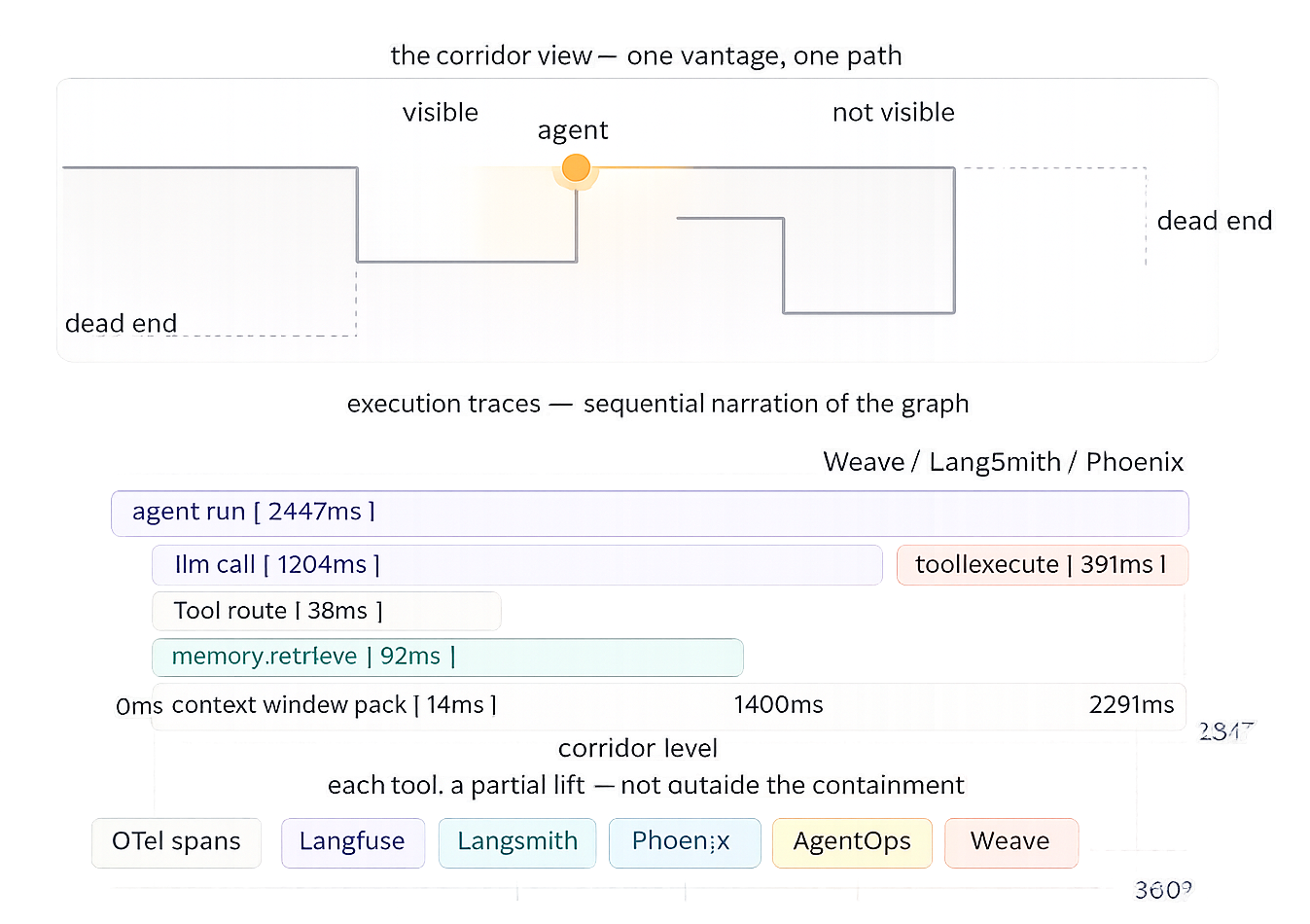
Each span, each diff, each automated investigation is an incremental vantage, revealing where an agent diverged from expectation. FastMCP’s recently added built-in support for OpenTelemetry, a core feature of last month’s v3.0 overhaul supplies spans for tool, prompt, resource, and resource template, providing visibility into request handling and delegation chains. This allows you to ship a single telemetry-ready codebase without forcing every environment to run a collector. (the labyrinth, now portable!) A flurry of Daedalusian wings, a new tool explosion not to be confused with the previous tool explosion, and not the folder explosion, although there do seem to be quite a lot of things exploding lately. Some explosions have CVE numbers, which means in theory they can be prevented, but in practice can just mean the maintainers moved the feature to an experimental package and went back to work. iykyk.
The potential explosion in LangChain’s SQLDatabaseChain (CVE-2023-36189) vulnerability is a fundamental failure to implement basic input sanitization in a production-ready framework. By allowing a Large Language Model to directly translate unvalidated user prompts into raw SQL commands, the library effectively bypassed decades of established security protocols, specifically the use of parameterized queries and the principle of least privilege. An attacker can use natural language to trick the model into exfiltrating the entire database or even executing administrative commands depending if the permissions are sufficiently locked down or not. (Spoiler: they’re not.) This isn't a sophisticated exploit btw; it’s a regression to the injection attacks of the early 2000s with the malicious payload being generated by a third-party API. But LangChain—the Minotaur’s poster child—attempts to solve the problem of complexity by wrapping it in more complexity, creating a leaky abstraction that eventually becomes the very thing you spend most of your time debugging. (Mad respect to Harrison tho, no cap.)
Theseus did not find his way out by being good at navigation, though he was legendarily so—also enormous, armed, and specifically heroic—with a pretty good track record of ending monsters by the time he got sick of watching his fellow Athenians get fed to that Cretan horror. He succeeded by following something that had brought with him into the labyrinth from outside and had never been subject to its containment logic at all, a connection to a point that predated each forward step, the last known good state, the only reference point the maze cannot corrupt, because it predates the maze’s structuring of space. Killing was the easy part (for him, anyway) but getting in and getting out are two different things — as anyone who’s ever unwittingly agreed to “hop on a quick call” well knows.
This is where Daedalus and Theseus are doing different things, and the difference is not a matter of style but a fundamental distinction between two categorically different operations. Daedalus rose above the system he had built. He could see the whole floor plan. He could see where the complexity had gone. What he could not do, from above, was rewind. The 360° view does not contain a path back to before you started. Nothing about flying really allows you to “un-fly” your soaring journey.
In a non-ergodic space the difference between those two things is the difference between knowing you are lost and being able to leave. Between knowing there’s a security threat, and mitigating it. So now you really do have two problems, which turn out, once you have separated them, to be a forced choice, and the choice was never about which problem to solve, which was inevitable, but strictly between the only two escapes the labyrinth has ever produced, and which of these you choose is the most important of all these problems to decide and this is the point you should probably be asking yourself which you picked.
(Spoiler: Theseus is sine qua non.)
A Common Thread
Here is where the two problems that felt like one problem separate for the first time, and here is where the three operations that felt like invariants reveal themselves as categorically different things: Daedalus above the system seeing everything and returning to build more; Ariadne outside the system holding the connection while Theseus is inside the system killing things. The three of them not so much invariants let alone a hierarchy let alone a sequence, but three different relationships to the containment logic, one of which produces an exit, which one requiring all three to be present simultaneously, which they were, once, in Crete, and have not reliably been since. At least not in any software suites we’ve shipped yet.
Daedalus has a bird’s eye view. Literally. 🪽 Soaring above the maze, living the dream of the 360° dashboard view. And ultimately having a bit of a come down and ending up right back where he started in the salt mines of monster containment. Theseus, OTOH, could not see the whole thing. He had no vantage point above the containment logic, no totalizing view, no dashboard. But also, he had no need of one. This meant he didn’t simply lose his way when the lights went out. The exit condition itself (which we know can only be ‘0’ or ‘1’) was not visibility but the integrity of the connection. He could follow it back in the dark. Daedalus could see everything and ended up right back where he started. Theseus could see almost nothing and went home (probs in too much of a hurry, tbh) thanks to a single, critical innovation: the thread.
A connection to a point that predated each forward step. The last known good state.
viz. The incorrigible reference point that predates the maze’s authority over the space.
Ariadne’s thread functions as rollback. Not rollback in the casual sense of “we can always revert” (The classic backups-are-not-DR mistake) and not the runbooks that exist or the rollback procedures that are documented or the skills that in some installations are literally named ROLLBACK.md. Rollback in the precise sense of an unbroken, version-controlled, continuously maintained record of every state transition the system has made, legible enough to traverse in the dark, trustworthy enough to follow when you have zero trust for anything else and not colocated in a SPF like the disaster recovery plan saved exclusively in the Confluence space that’s unreachable when AWS us-east-1 goes down because Kiro’s slipped its guardrails again. (Spoiler: what guardrails?)
And not version control, with which its often conflated, (threading thought of as a better version of Git), which is interior, but the commitment to follow version control back to a specific point regardless of what the maze looks like now, which commitment is not a promise but a preparation. You cannot prepare retroactively Once you’re in it, you’re in it. Theseus enters chord in hand before ever crossing the threshold, and still, it is not the thread but the holding on, and the understanding of exactly who is holding the other end, and knowing neither will be the first to let go, which is most obviously not a skill, any more than the thread is a tool. But Brooks was not describing a skill; he was describing an orientation. The string is that orientation, operationalised: the Off-Chain truth that prevents the On-Chain hallucination from becoming terminal.
The question of who now holds the thread (and how long the the connection should be held open for) is a question engineers, despite our rush to name the folder and the skill and the soul, and measure the benchmarks and commits and PRs, have not yet answered, not because the question is unanswerable but because answering it requires admitting that finding your exit depends on something that cannot be committed to a repository, cannot be progressively disclosed, cannot be triggered by a matching skill, and cannot be inside the system it is intended to pull you out of, and most distressingly of all—whether you think models have feels or not—cannot be a file named for the one thing it cannot contain, cannot be the Cotardian soul file with no fixed point of reference and no working memory of state history.
Beyond Observability
The 360° view does have a fixed point of reference. It does provide a time travel view of state history. It doesn’t necessarily give you a way back. Observability without rollback; a comprehensive map of a space you cannot leave. Wings can give you a higher vantage but the thread shows you the solution path. Together they are the two exits from a non-ergodic space. And yet.
Observability continually expands as a consequence of the conservation law operating as designed. Every reduction of a complexity invites a dashboard to disambiguate the mystery left in its place. Like the Labyrinth, every new instrument added is (assumed to be) a locally correct response to the backpressure the previous instrument failed to relieve. Don’t make me say “Janet would recognize this.” (Ok so I said it but in scare quotes.) The field narrowing in exact proportion to the energy required to maintain the dissociation; the Labyrinth growing in exact proportion to the energy required to skirt the question it was created not to have to answer.
The map expands; screens multiply. There is always a new data point to be instrumented, a hot new view to be added to the dashboard. (Thanks, OpenClaw!) Every modal improvement, from events to agents reading the dashboards they helped generate and running their own queries from within, recursion already productized in things like Honeycomb’s Agent Skills for Anthropic’s Claude Code and Cursor that let the agent instrument itself, is either the visibility problem solved or the visibility problem perfected. The labyrinth grows through active telemetry because instrumentation was encoded inside the containment logic it was built to observe, non-terminating by design, each local response to previous pressure relocating the complexity one level up with better tooling and new schema layers and more committed practitioners convinced the argument had been left behind, or at least at the bar.
But not every improvement is equal or should we say some are more equal than others. Modern observability’s killer move is that high-cardinality ad-hoc queries let you ask questions you didn’t know you needed to ask until the incident was already happening. As powerful a tool as that is however it doesn’t give you rollback. State history, no matter how sophisticated, is not state recovery. And recovery is a much harder problem in a non-ergodic space.
Observability is non-terminating
State history is not state recovery. Knowing every position you have occupied in a non-ergodic space per se doesn’t tell you which one is safe to return to, does not tell you whether the path back is intact, does not tell you whether the system you are restoring into is the system that produced the state you are restoring from, does not tell you if CVE-2025-67644: SQL injection through the checkpointing layer’s metadata filters has already corrupted your database. Provenance is inside the Labyrinth. Move it to the infrastructure (execution as audit trail, workflow history as first-class primitive, the recovery logic external to the application) and you have Temporal which is better, but still inside the containment logic it’s meant to recover, the judgment about when to follow the thread back not in the infra but in who’s running it, which is increasingly an agent, which is also inside the Labyrinth, and increasingly so, which is the problem restated one level up with better tooling.
First we instrumented what we predicted. Then we instrumented what we hadn’t. Both are execution bounded; both watch what the system does after the model reads the specification. Neither watches what happened to the specification between the last commit and this one, the delta between specification states, the change in the behavioral contract over time, its provenance.
Provenance is Ariadne’s primitive. Not provenance in the compliance sense, not the audit trail that exists to satisfy a regulator. Provenance in the precise sense: who touched what and when and from where, in an unbroken sequence that predates the current deployment, maintained with enough integrity to follow backward to a state you know is good, from which you can reason forward, against which you can diff everything the system has become since. The one thread in the entire stack that is not inside the containment logic it is designed to navigate out of, because the thing that makes it work is that it was not inside to begin with.
It’s not a new dashboard. It’s not a new query interface. It’s the instrumentation of reversibility itself; who touched what, when, from where, (compaction is why*) maintained continuously from before the threshold was crossed, external to the system, traversable under loss of visibility. CLI tools aren’t pointing at a gap in observability. They’re the embryo of an entirely different category that the market hasn’t named yet because naming it requires admitting that observability, even at its most sophisticated, is a read operation on a system you cannot leave, and what comes after it is the write operation that happened before you entered that state in history.
Observation and restoration share infrastructure, including traces, snapshots, and logs but the market has not yet forced a clear distinction because the distinction only becomes visible at the moment of failure, when seeing what went wrong doesn’t give you the ability to restore that system state. Which is precisely when you discover your observability stack and your recovery primitive were the same product wearing different labels and one of them doesn’t actually work.
The Other End
The Minotaur lurks in the lacuna between observability and recovery. Not the gap between knowing something went wrong and knowing what went wrong; modern observability closes that shortfall. The gap between knowing what went wrong and being able to restore the system that produced the state you are trying to restore into. The liminal space between the map and the exit. Between seeing every position you have occupied in a non-ergodic space and knowing which one is safe to return to, whether the path back is intact, and whether you'll be the same once you get there.
At the boundary between build-time schema diffing—not a runtime alert, not a trace, nothing to send to OTEL—and runtime instrumentation: a behavioral diff against a prior contract state, an external reference, a continuous record, a pull from outside. Provenance targeted tools that scan for behavioral changes with no code diff, the drift between the instructions given to the system and its actual output, for which there is no dashboard alert, no execution event, nothing in O11y 1.0 or 2.0 or 2.5 (or O11y 5.0 if you worked at Block) that was ever built to catch it because it happens prior to execution, in the gap between what the system was told to do, what was expected to happen and what the model will actually do when it executes. Textbook POSIWID.
The system is what it does. Not what the specification says it does, not what the soul doc encodes, not what the skill file describes, not what the benchmark measures, not what the dashboard shows, not what the PR said it would do when the ticket was marked resolved. Beer said this in 1972 and it has not stopped being true for one minute since, and a minute went a lot farther in 1972 and the folder explosion is what it looks like when an industry responds to this phenomenon by building increasingly sophisticated descriptions of what the system is supposed to do and calling the description the system, which is the category error the soul doc committed at the moment of naming and which the provenance gap makes visible only at the moment of failure, when the description and the behavior have drifted far enough apart that the dashboard catches the delta and the rollback primitive is either there or it isn't.
This unbroken chain of custody between what the system was told to do and what it actually did, maintained from before the walk began, external to the containment logic, traversable in the dark, by someone who has not confused the map for the territory or the soul doc for the soul or the ticket marked resolved for the corridor no longer growing. Ariadne's primitive works because it’s the only one whose integrity is not a function of the system it is designed to navigate out of. But where did she get it?
Twas Daedalus who gave her the clew.²
The knowledge that produces the containment is the same knowledge that produces the exit, but only if it is externalized before the threshold is crossed, before the walk begins, before the system becomes the only reference frame available to those inside it. The thing outside you were connected to before you entered, and that will be outside when you leave. Control plane and data plane hiding in plain sight as usual.
Which still invites a question to be asked. Which is, if you have followed the thread this far, the only question that was ever worth asking. Not that the lift from the wings isn’t real. Not that the vantage isn’t extraordinary. But the knowledge that produced the containment is the same knowledge that produces the exit: provenance is not a parallel instrument to observability; It’s what observability becomes when it finally understands what it was always pointing at.
It’s the prior relationship between the person inside the system and the vantage outside it, the one who holds the other end, the one who does not let go, the one whose existence cannot be encoded in YAML and whose absence cannot be detected by any linter running in any CI pipeline connected to the Internet connected to any of the millions autonomous agents, each of them carrying a file named after the thing that was supposed to replace this relationship and did not, because the relationship was never a file, and Daedalus knew this, and paid for revealing it, but the thread worked as designed, and Theseus got out, and the labyrinth is still there, still non-ergodic from every entry point, still conserving exactly as much complexity as the problem that produced it, the exit invariant, the walls load-bearing, and from inside the completeness of that solution, the question is asked: Who is holding the other end?
An ending is what you arrive at when you've held the thread.
The end is what happens to you when you haven't.
Next Stop Naxos
How Dionysus tricked Theseus on Naxos is a story we’ll save for another day. (Or you can read all 768 pages of Metamorphoses yourself.)
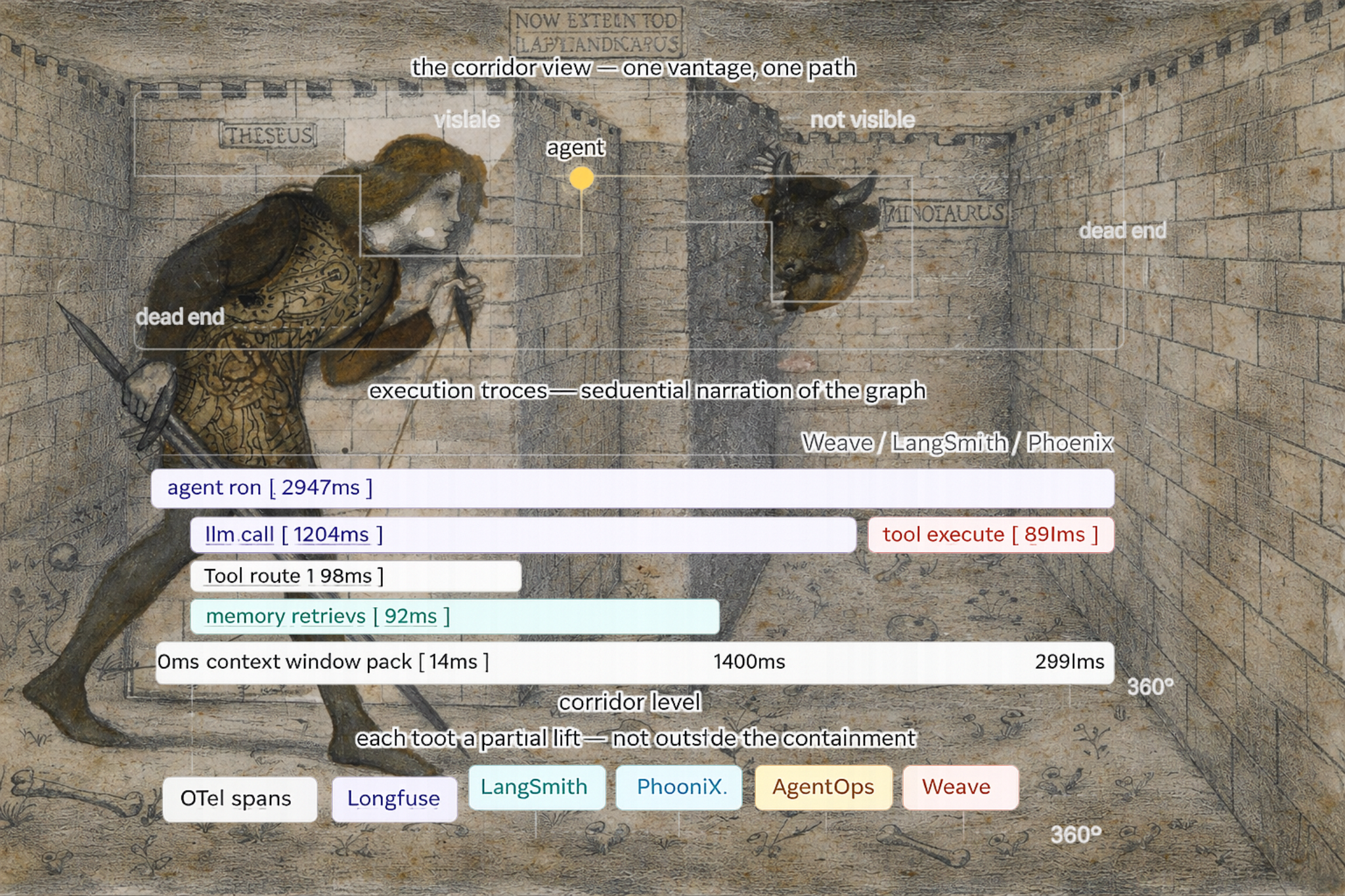
It’s actually fine if you have the thread in hand. (But woe if you don’t.)
Notes
[ 0 ] “Που Ειναι η Μίτος Σου” (Pou Einai i Sou Mitos?) Theseus, where is thy string? But for anyone who missed it, ‘STR’ is a pun on steps to reproduce.
[ 1 ] I do understand that idiomatically ‘probs’ is preferred but I’ll always defend prolly which has been tragically maligned.
[ 2 ] ‘Clew’ is the Old English word for a ball of string, from which ‘clue’ is derived.